Paint.NET v3.35 final release now available!

This version has a new Posterize adjustment, Intersect selection mode, and dramatically faster selection editing performance (add, subtract, intersect). Oh, and the usual crop of miscellaneous bug fixes, of course!

You can get this update by using the built-in updater (Help menu -> “Check for Updates”), or by downloading it from the website at http://www.getpaint.net/ . The update process is very automated, so you won’t need to worry about uninstalling your old version or anything — it’s all taken care of for you.

Changes:

· New: Posterize adjustment, by Ed Harvey.
· New: Intersect selection editing mode.
· Improved: Dramatically improved selection editing performance for the Add and Subtract modes (and also for Intersect). The performance used to be dependent on image size, and thus was often unusable on images larger than 1024×768 pixels. It is now dependent only on selection complexity (number of polygon edges) — the improvement is generally between 3x and 1000x.
· New: When holding Ctrl or Alt for a selection tool, the cursor now has a plus or minus indicator.
· Changed: The canvas background is now a solid color instead of a gradient. The gradient was causing certain tone misjudgments related to bright versus dark colors.
· Changed: Shortcut key for Sepia is now Ctrl+Shift+E. The shortcut for Posterize is now Ctrl+Shift+P.
· Changed: Hotkeys for selection modes are now Left click for Replace, Control+Left click for Add (union), Alt+Left click for Subtract (difference), Alt+Right click for Intersect, and Ctrl+Right click for Invert (xor).
· Changed: When using a selection mode other than “replace”, it will now draw the selection outline so that you can see both the original and resulting selection areas. Before, it would only draw the resulting selection area outline, which made modes such as Intersect hard to use.
· Fixed: The Resize dialog had some rounding errors with the “Maintain aspect ratio” feature, which caused a few discrepancies and even a spurious “out of memory” error.
· Fixed: Some quirks with the Color Wheel control for IndirectUI-based effect plugins.
· Fixed: Several miscellaneous and rare crashes.
· Fixed: The installer would display a bizarre error if a “blank” install folder was attempted.
· Fixed: The installer now only accepts absolute path locations, instead of relative ones. This fixes an ambiguity between where Paint.NET believes it is installing itself to, and the directory that Windows Installer actually uses.
· Fixed: Sometimes pasting would result in a crash when certain types of malfored data were on the clipboard.
· Fixed: It was possible to get around some of the protections imposed by the IndirectUI system. This was causing instability with some effect plugins such as “Fern Fractal”.
· Fixed: There were some issues with the implementation of “linked” sliders for effects based on IndirectUI.

Enjoy!

C# Extension Methods … Portability Aid?

In my first post about Paint.NET v4, I mentioned that I was learning a lot about C# 3.0 and .NET 3.5. One of the things I’m absolutely falling head-over-heels for is extension methods.

One use of these is to add utility functionality on to existing classes that you don’t own the implementation for. As an example, consider the System.Uri class. In my opinion, it could use an Append method:

public static class UriExtensions
{
    public static Uri Append(this Uri baseUri, string relativePath)
    {
        return new Uri(baseUri, relativePath);
    }
}

You can then use code such as this:

Uri donateUri = new Uri("http://www.getpaint.net").Append("/donate.html");

Instead of:

Uri donateUri = new Uri(new Uri("http://www.getpaint.net"), "/donate.html");

(Bear in mind that the string literals would probably be pulled out of a list of constants, and not inlined like in the code above.) In this case, we’re simply enabling a choice of coding style and not really doing anything new. We are avoiding pathological nesting such as "new Uri(new Uri(new Uri(…" for when we need to paste together multiple relative Uri paths.

One place I’m finding extensions methods to be very useful is in defining and implementing interfaces with only strictly orthogonal functionality. You don’t need to add utility methods to interfaces, you can simply define them as extension methods.

For example, my resource manager is contained in an IResourcesService interface that has GetString() and GetBinaryStream() methods. And that’s it.

using System.IO;

namespace PaintDotNet.Framework
{
    public interface IResourcesService
    {
        string GetString(string stringID);
        Stream GetBinaryStream(string streamID);
    }
}

All resources other than strings are stored as binary streams, such as icons, bitmaps, text files, etc. If you want to load a bitmap, then you can use the handy extension method:

using System.Drawing; // pull in GDI+

namespace PaintDotNet.WinForms
{
    public static class ResourcesServiceExtensions
    {
        public static Bitmap GetBitmap(this IResourcesService resources, string streamID)
        {
            return new Bitmap(resources.GetBinaryStream(streamID));
        }

        // similarly for GetIcon, GetCursor, etc.
    }
}

… elsewhere in the code …

menuItem.Image = Resources.GetBitmap("Icons.MenuFileExitIcon.png");
    // Resources is a local property that gets the IResourcesService assigned to us

I could have multiple implementations of IResourcesService. For example, I could have the "normal" implementation that pulls from the local file system, then a test version that does all sorts of fakery, and then maybe experiment with one that loads all my resources via HTTP GET. But, I only ever need one implementation of GetBitmap() because it is just a helper method sitting on top of GetBinaryStream().

But wait, there’s more!

GetBitmap() returns a reference to a System.Drawing.Bitmap object. You generally only care about this type if you’re writing a WinForms application (which I am doing). Or, put another way, you wouldn’t want an object of this type if you were writing a WPF application. You’d want a BitmapSource or something. I am not writing a WPF version of Paint.NET v4, but one of my goals is to have the ability to write one. This is where the "separation of UI and logic" comes into play from my previous post. I refer to the WinForms UI as the shell. The "business logic" portion of the code base is referred to as the application (app for short). You could potentially have a WPF shell, or a command-line shell. Or you could write your own UI toolkit that P/Invokes straight to the Win32 API and bypasses WinForms completely (I believe the latest Zune UI does this).

So, if we wanted a WPF shell for Paint.NET, we could still use the same interface and implementation for IResourcesService. No changes needed anywhere. Why should the resource loader care about what UI you’re using? Its job is to give you strings and binary streams. It’s your job to parse them. It shouldn’t need a reference to the likes of System.Drawing.dll or PresentationCore.dll.

Thus, we’d probably find the following extension method setup useful in our hypothetical WPF shell:

using System.Windows.Media.Imaging;
namespace PaintDotNet.Wpf
{
    public static class ResourcesServiceExtensions
    {
        public static BitmapSource GetBitmapSource(this IResourcesService resources, string streamID)
        {
            return …; // not sure what code goes here exactly 🙂
        }
    }
}

The WPF-based shell would never pull in the PaintDotNet.WinForms namespace, and would instead use the PaintDotNet.Wpf namespace. They’d almost certainly be in separate DLL’s. So these two static extension classes will never collide, even if they have similarly named methods.

Using extension methods this way is probably preferable to "interface inheritance" for adding utility methods. For example, now I don’t need to declare a IWinFormsResourceService that derives from IResourcesService. I can avoid putting all the utility functionality into the base interface which could cause headaches.

As another example of only implementing "strictly orthogonal functionality", consider the case of the System.Windows.Threading.Dispatcher class and its CheckAccesss() and VerifyAccess() methods. The latter basically calls the former and converts true/false into return/throw. It could be done as an extension method. In fact, I have my own IDispatcher interface in Paint.NET v4, and this is exactly what I do. For sections of my code that are P/Invoke heavy, I’ve found it useful to have a SizeOf() method attached to any struct, as opposed to calling Marshal.SizeOf(Type). Less keystrokes, and I think it improves readability.

Yet Another Poorly Done Business Proposal

I can’t make these things up, folks. I honestly feel that if someone really wants to do business with you, they’ll at least do more than 3 seconds of research and get your product’s name correct. It should be easy to figure out that the product hosted at http://www.getpaint.net/ is called Paint.NET, and not "Get Paint." The logo is only emblazoned at the top of every page…

Hello,

Our company, Firstlook, is currently seeking partners to distribute our latest software product, SearchInOneStep.com.

With 10 million active users of search software and a stellar record in the search industry, we feel we would be a great match with Get Paint.

Get Paint attracts a large number of downloads, with which our software could be easily bundled during install to provide an alternate steady source of risk free revenue  which goes directly to your bottom line.

We offer our bundling partners the option to be paid per download and would be open to any volume of downloads that your company could provide.

Please feel free to contact me at your earliest convenience if you are interested in monetizing your downloads with Search in One step.  I look forward to discussing this matter with you further.

Thank you,

Sanjay

Well, Sanjay, my product is not called "Get Paint". I went to the website and tried the "search in one step" and it’s garbage. All it does is syndicate a bunch of ads. There aren’t even any search results! So I told Sanjay that I would not be doing business with him.

As for everyone else, if you want a good search engine for Paint.NET stuff, might I recommend http://searchpaint.net instead? 🙂

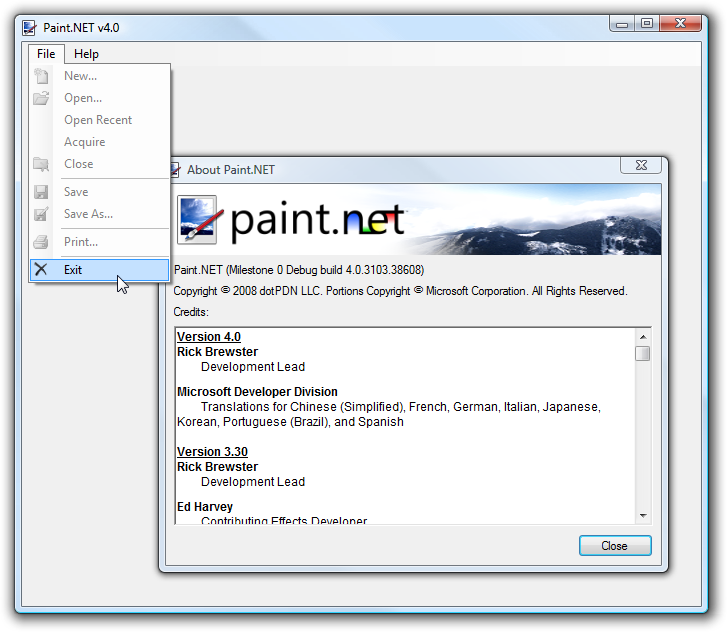
The very first Paint.NET v4.0 screenshot!

It’s really not as exciting as it sounds unfortunately 🙂 I’ve been quiet on the subject for some time, though, and wanted to put out some information.

For a long time I debated whether I should fully refactor Paint.NET, or do it from scratch. I finally decided on the latter, and have finally been able to make some progress. Bear in mind that "from scratch" means that I started with a brand new, empty solution file in Visual Studio. It does not mean I’m throwing out all the current Paint.NET code. There are many places where I will be able to reuse vast amounts of it — rendering kernels, effects, math, algorithms, etc. The entire structure of the program will be different, however. If you demolish your old house to build a new one, you don’t throw out the grand piano in the living room too. It still has plenty of value.

The screenshot above is from a build that so far contains about 12,000 lines of code. This sounds like an exorbitant amount for a few menus and an About dialog, but hear me out. I’m building it using Inversion-of-Control (IoC) and related patterns, which requires a lot of new decisions to be made regarding assembly layout (layering, essentially). I’ve also got a new system for asynchronous programming, separation of UI and logic, separation of "contract" and "implementation" assemblies (this becomes very important when plugins come into play), command routing and handling, etc. Along the way I’m learning more about .NET 3.5 and C# 3.0, and have come across some wickedly cool things that are now possible.

As far as possible, everything is lazy initialized or loaded in Paint.NET v4. To aid this, I have a new asynchronous programming model and exception handling pattern, which I could probably talk about for hours. For example, in the screenshot above, the icons for the menu items are not loaded until you click on the menu — in fact, they are loaded using background threads (the threadpool). The graphics and rich text that populate the About dialog are also loaded from the resource manager service using a background thread. For these specific cases, there are no major performance requirements that necessitate this; however, it’s much easier to solve these simple cases and to establish good patterns for later, than the reverse. I’ve also got an old Pentium 4 that I now have available for baseline performance testing, and it will be interesting to see if I can keep the program as responsive on that system as on my Core 2 Quad — even if rendering kernels take longer to complete, it should still always immediately respond to input. *crosses fingers* (Anyone else get sick of Safari on iPhone not being responsive while loading some web pages? Yeah.)

Also, in the screenshot you may notice that the mouse cursor is resting in the File menu even though the About dialog is open. In Paint.NET 3, all dialogs are modal and you can’t do anything with the rest of the program while one is open. In Paint.NET 4, I’m trying to remove this as much as possible and as far as it makes sense to. For example, why should an update download prevent you from using the rest of the program? Why can’t you switch from image 1 to image 2 while a compute-intensive (aka, "takes a long time") effect is rendering on image 1? Why can’t you interact with the canvas while an effect dialog is open? Or change the selected colors?

Anyway, that’s all for now. I estimate that Paint.NET v4 will be 200,000 lines-of-code when it is done, which places me at about 6% complete.

Paint.NET v3.35 – Beta 2 is now available

This is a refresh of the beta with some good changes to the new features, and many bug fixes.

Please note that this is a beta, and expires in August. You can get it by downloading it from the website, http://www.getpaint.net/ (no need to uninstall your current version, it will figure it all out for you), or via the built-in updater. For the latter, go to Help -> Check for Updates… and make sure you are set up to receive betas by clicking on the Options button and ensuring that “Also check for beta releases” is checked. Then close the dialogs and click on Help -> Check for Updates… again.

Ok now that this is done I can get back to working on my blog posts about Fluent Exception Handling 🙂

Changes since Beta 1:

· Changed: When using a selection mode other than “replace”, it will now draw the selection outline so that you can see both the original and resulting selection areas. Before, it would only draw the resulting selection area outline, which made modes such as Intersect hard to use.
· Changed: The canvas background is now a solid color instead of a gradient. The gradient was causing certain tone misjudgments related to bright versus dark colors.
· Changed: Shortcut key for Sepia is now Ctrl+Shift+E. The shortcut for Posterize is now Ctrl+Shift+P.
· New: When holding Ctrl or Alt for a selection tool, the cursor now has a plus or minus indicator.
· Fixed: The Resize dialog had some rounding errors with the “Maintain aspect ratio” feature, which caused a few discrepancies and even a spurious “out of memory” error.
· Fixed: Some quirks with the Color Wheel control for IndirectUI-based effect plugins.
· Fixed: Several miscellaneous and rare crashes.
· Fixed: The installer would display a bizarre error if a “blank” install folder was attempted.
· Fixed: The installer now only accepts absolute path locations, instead of relative ones. This fixes an ambiguity between where Paint.NET believes it is installing itself to, and the directory that Windows Installer actually uses.

Paint.NET v3.35 BETA is now available

Alright, here we go again 🙂 This releases introduces a new Posterize adjustment, a new Intersect selection mode, and dramatically improved performance for selection editing.

Please note that this is a beta, and expires in August. You can get this by downloading it from the website, http://www.getpaint.net/ (no need to uninstall your current version, it will figure it all out for you), or via the built-in updater. For the latter, go to Help -> Check for Updates… and make sure you are set up to receive betas by clicking on the Options button and ensuring that “Also check for beta releases” is checked. Then close the dialogs and click on Help -> Check for Updates… again.

Enjoy!

* New: Posterize adjustment, by Ed Harvey.
* New: Intersect selection mode.
* Improved: Dramatically improved selection editing performance for the Add and Subtract modes (and also for Intersect). The performance used to be dependent on image size, and thus was often unusable on images larger than 1024×768 pixels. It is now dependent only on selection complexity (number of polygon edges) — the improvement is generally between 3x and 1000x.
* Changed: Hotkeys for selection modes are now Left click for Replace, Control+Left click for Add (union), Alt+Left click for Subtract (difference), Alt+Left click for Intersect, and Ctrl+Right click for Invert (xor).
* Fixed: Sometimes pasting would result in a crash when certain types of malfored data were on the clipboard.
* Fixed: It was possible to get around some of the protections imposed by the IndirectUI system. This was causing instability with some plugins.
* Fixed: There were some issues with the implementation of “linked” sliders in IndirectUI.

What's coming in Paint.NET v3.35

This next update to Paint.NET will fix the usual set of small bugs, introduce a new adjustment (Posterize), fix a major performance blemish related to selections, and add an Intersect selection mode.

As for the small bug fixes, turns out there’s the possibility that Paint.NET will crash if malformed data is in the clipboard from, of all things, certain WPF-based applications. For effects that use IndirectUI, there was a problem with "linked" sliders (using LinkValuesBasedOnBooleanRule). And, it was possible to get around some of the protections that IndirectUI put up to protect Paint.NET from certain types of plugin code. Currently this only seems to affect the Fern Fractal plugin. I’ve e-mailed the author and helped him to find a way to accomplish what he wanted without "breaking the rules," so to speak.

Posterize is an adjustment written by Ed Harvey. It allows you to restrict each of the red, green, and blue channels to only have between 2 to 64 discreet values. Normally each channel has up to 256 values … 0 through 255, which is the range for a byte. This can be useful to give your image a "faux-dithered" look, although of course there are many other creative ways to use it.

Selection performance has been a major sore point in Paint.NET over the last 3 years or so. The initial drawing of a selection is fine — it’s when you go to use union (add) or difference (subtract) combination modes that things get froggy. Really froggy. As in slow. Pathetically slow.

We’ve been using a very brute force algorithm that converts the selection to a bit-mask, then performs the boolean operations on each bit, and then traces the bitmask to recreate a selection path (selections in Paint.NET are stored as a a polygon list). This causes these operations to have performance that is proportional to the number of pixels in the area where the selection is located (its bounding rectangle, actually). On a large or even medium-sized image, these are immediately prohibitve to use. This algorithm was originally developed for use by the Magic Wand tool so that we could do per-pixel tolerance, and then convert back to the polygon representation that was required everywhere else in the application.

There are algorithms that have been developed with let you do boolean algebra operations on the polygons themselves, optimizing away this very hacky (albeit correct!) way of doing things. One such algorithm is detailed in a 1992 paper by Bala R. Vatti titled, "A Generic Solution to Polygon Clipping." This is the algorithm implemented in the GPC (General Polygon Clipper) library written by Alan Murta from the Computer Science department at the University of Manchester in England. There are other algorithms that have been developed since, such as the one described in a 1998 paper by Günther Greiner and Kai Hormann titled, "Efficient Clipping of Arbitrary Polygons".

I have read both papers and tried to implement both of the algorithms. I have tried this several times, and have come close to completion but never quite made the leap to full comprehension, nor a finished implementation. I never had more than an evening or two in a row to devote to this pursuit — by my estimate, I would need at least a full two or three weeks. Maybe even a full month. These papers are from the academic world, and I haven’t had much practice there for quite some time! As such, the papers are very dense (in a good way) and require many readthroughs to fully understand.

I was never able to find a good implementation of the second algorithm by Grenier and Hormann, which was desirable because it was simpler and supposedly more efficient. In the end, GPC by Alan Murta won out: like previously mentioned, it is an implementation of Vatti’s algorithm, in C. It has been around for quite awhile and has needed no major revisions in many years. So, from an integrator’s standpoint (me!), it is the simplest and safest solution. I am happy to say that I have just purchased a Commercial Use license from the University of Manchester and that the next update to Paint.NET will be using it to substantially increase performance for selections!

This is a simple case of pragmatism versus idealism: ideally, I would have the time, the patience, and the mental acuity to implement these. In practice, it would take so long to do this myself that the cost of a Commercial Use License is actually the cheaper alternative. So for everyone who has donated to Paint.NET, this is how I’m using your money 🙂 This does affect anyone interested in using the Paint.NET source code for their own commercial purposes: if you need any of the code related to selection stuff, you will have to purchase your own Commercial Use License from the University of Manchester.

The only way to get a feel for the performance increase is to cheat a little, with the current version of Paint.NET. Boot it up and create a 1024×768 image. Now, draw a circle selection that encompasses the whole image. Next, go to the toolbar and where it says "Selection Mode:", click on the down-arrow and choose "Subtract." Next, Draw another circle that is inside of the one you just draw. It’s very very slow. Next, undo this foolish thing you just did. Set the "Selection Mode:" to be "Invert (xor)" (this is the one mode that GDI+ gives you for free!). Now draw that second circle again and notice how smooth everything is. In the next update, this performance will also be there for Add (Union) and Subtract! The usability improvement is real and honest, and I think everyone will really like it.

Next, I’ve decided to add an Intersect selection mode. I’m not sure why I never did this before, to be honest. It was trivial to do, especially since GPC supports it right out of the box. Many other drawing programs offer this — it simply makes sure that the result of combining two selections is the area in which they overlap.

Last, I’m reassigning the keyboard shortcuts for the selection modes. Before, you would hold Control for Add/union, hold the right mouse button for Subtract/difference, and Control+Right for Invert/Xor. These are kind of weird, and non-standard, and plus I needed a key for Intersect. So, in the next update the shortcuts will be Control for Add/union, Alt for Subtract/difference, Control+Right mouse button for Invert/Xor, and Alt+Right mouse button for Intersect.

I’m hoping to have a beta of v3.35 out within a few weeks, and the final release in early-to-mid July.

Software Developer Tip: RSS Aggregator + Google Blog Search

Large companies, such as Microsoft or Google, have entire sections of their company dedicated to things like PR (Public Relations) and paying attention to what the media says about them. As a small time individual developer, you probably don’t have time to track down everything that is said about your product. But, if you know how to use an RSS Aggregator such as RSS Bandit or Google Reader, then you can passively (efficiently) watch a lot of the buzz about your product.

The trick is to use the RSS syndication feature in Google Blog Search. Basically you do a search for your product’s name, and then you click on the button to get an RSS feed for that search query. Whenever you check in on your RSS feeds, you’ll know if people have been talking about your product in the “blogosphere.”

Step 1 — Go to Google Blog Search and type in your product’s name. Usually you want to surround it with quotes.

Step 2 — On the top right side inside the browser window, click on “Sort by date”. The default is to sort by relevance.

Step 3 — On the left side of the window, find where it says “Subscribe:” and then click on the format that you prefer (I use RSS, for instance).

Try it out 🙂 I use this to keep up on what people are saying about Paint.NET — both good and negative.

Paint.NET Help: Now with Windows Live Translator

One problem that a small software developer like myself faces is getting my software and its help content available to users that don’t speak my language. Translating something like the Paint.NET Help is a daunting task — it’s a lot of content, so it either takes a lot of time, or a lot of money.

Machine Translation (MT) gets a bad rep because it usually provides laughable, hardly usable translations. It is, however, very cost effective. So, I have added the Windows Live Translator widget to the Paint.NET Help. Hopefully it can help non-English users get the gist of the help content, while at the same time adding some more feedback into the Windows Live Translator system. Who knows, maybe someday it will be almost as good as a “real” translation 🙂

If you use this, then please send feedback via the “Is this translation useful?” link at the top of the Windows Live Translator shell.

PC Club stores close … I used to work there!

So, I just saw over at HardOCP that PC Club has shut down completely. We had around 4 of them in the Seattle area (Lynnwood, Bellevue, Tacoma, and I think one more), although only the Tacoma one was still around. I actually worked there as a “sales associate” in the summer of 2002, between my junior and senior years of college. I thought it was a pretty decent place to work, although apparently things went downhill after the founder passed away (whom I met — he gave me an eBay coffee mug which I still have).


PC Club in Lynnwood, WA, circa 2002

Some [possibly] interesting bits of historical info:

· I was the top grossing sales person there during the months that I worked (summer, and during Christmas break). However, my margins were lower than the others. The cause? I’m not sure, but it’s probably because I just told the truth, or at least my honest opinion, when customers asked questions! If someone was buying a computer and couldn’t decide between an Athlon XP or a Pentium 4, and asked “What’s the difference?”, then I replied with “You probably won’t notice much, other than the $100.” Because of this I sold more systems, albeit at less profit margin. I never sold one of the $1,000 Pentium 4 2.53 GHz chips … oh well 🙂
· When games like Morrowind or Unreal Tournament 2003 came out, we sold a lot of graphics cards. The big dog at the time was the GeForce 4 Ti4600, but we sold a lot of the Ti4400’s.
· The week before I started working there, the place was actually robbed. The manager was helping a customer with some questions at the front counter, and when he turned his back for a second the customer reached over and yanked a tray of expensive Pentium 4 CPU’s. Then he ran. If it hadn’t been for this, the store would have been profitable its very first month in operation.
· One time we had a very interesting fellow walk in carrying some computer almanac. He demanded to know how the computers responded to some math problem … apparently he thought that the Pentium FDIV bug was still around.
· The manager wanted us to try and sell the LCD monitors used by the POS (point of sale) computers. Even though they were obviously used and a little dingy (from fingers, post-it notes, etc.) he refused to sell them as anything but full price and new. “They aren’t used!” Umm, yes, they were! The customers he tried to sell them to weren’t exactly impressed (nor fooled).
· We had one guy come to the story regularly just to hang out and talk. He had a job as one of those guys who stands on the sidewalk wearing a sign that says, “Carpets For Sale!”, with a big arrow. He was a mostly normal guy, not a bother or anything … apparently they actually get paid good money to do that since it’s really hard to retain them.